

Hotel Red Flags: What Travelers Should Check First Before Booking
A hotel can look excellent online and still disappoint when you arrive.
The photos may look polished. The rating may look strong. The location may seem convenient. The description may sound reassuring. But many hotel problems are not obvious from the booking page alone.
The real warning signs often appear in patterns. One guest may mention that the room felt dated. Another may mention noise. Another may say the hotel was “fine for one night.” Another may say the staff was nice, but the room could have been cleaner. Individually, these comments may not seem serious. Together, they can reveal a stay that may not match what you expect.
That is why hotel red flags are not only about dramatic complaints. They are often about repeated signals: vague praise, cleanliness comments, noise concerns, maintenance issues, hidden fees, service gaps, or a mismatch between the price and the actual stay experience.
Hotel red flags vs. Airbnb red flags
Hotel red flags are usually different from Airbnb and vacation rental red flags. With hotels, the main risks often come from room condition, housekeeping consistency, noise, service quality, hidden fees, outdated facilities, and whether the hotel actually matches its rating and photos.
Airbnb and vacation rental red flags are more property-specific. You are usually evaluating one exact home, one host, one access setup, one cleaning process, one rulebook, and one neighborhood location. A hotel may have many rooms and staff members, but a vacation rental depends much more heavily on the individual listing.
That is why travelers should check hotels and vacation rentals differently before booking. For hotels, focus on repeated guest complaints about cleanliness, maintenance, sleep quality, staff response, fees, and room condition. For Airbnbs and vacation rentals, pay closer attention to host communication, check-in instructions, house rules, cleaning fees, misleading photos, exact location, and whether past guests describe the stay the same way the listing does.
A hotel can look excellent online and still disappoint when you arrive.
The photos may look polished. The rating may look strong. The location may seem convenient. The description may sound reassuring. But many hotel problems are not obvious from the booking page alone.
The real warning signs often appear in patterns. One guest may mention that the room felt dated. Another may mention noise. Another may say the hotel was “fine for one night.” Another may say the staff was nice, but the room could have been cleaner. Individually, these comments may not seem serious. Together, they can reveal a stay that may not match what you expect.
That is why hotel red flags are not only about dramatic complaints. They are often about repeated signals: vague praise, cleanliness comments, noise concerns, maintenance issues, hidden fees, service gaps, or a mismatch between the price and the actual stay experience.
Hotel red flags vs. Airbnb red flags
Hotel red flags are usually different from Airbnb and vacation rental red flags. With hotels, the main risks often come from room condition, housekeeping consistency, noise, service quality, hidden fees, outdated facilities, and whether the hotel actually matches its rating and photos.
Airbnb and vacation rental red flags are more property-specific. You are usually evaluating one exact home, one host, one access setup, one cleaning process, one rulebook, and one neighborhood location. A hotel may have many rooms and staff members, but a vacation rental depends much more heavily on the individual listing.
That is why travelers should check hotels and vacation rentals differently before booking. For hotels, focus on repeated guest complaints about cleanliness, maintenance, sleep quality, staff response, fees, and room condition. For Airbnbs and vacation rentals, pay closer attention to host communication, check-in instructions, house rules, cleaning fees, misleading photos, exact location, and whether past guests describe the stay the same way the listing does.
Hotel red flags before booking
Hotel red flags are warning signs that a property may not match what travelers expect from the listing, rating, photos, or price. They do not always mean a hotel is bad. They mean the hotel deserves a closer look before you commit.
A single negative review does not automatically make a hotel risky. Every property can have occasional issues. The stronger signal is repetition. If multiple guests mention similar concerns, even in polite or softened language, that pattern matters more than one dramatic complaint.
For example, one guest saying a room was noisy may not mean much. But if several guests mention street noise, thin walls, hallway noise, nearby bars, or poor sleep, that becomes a real sleep-quality signal. The same logic applies to cleanliness, maintenance, value, location, and service.
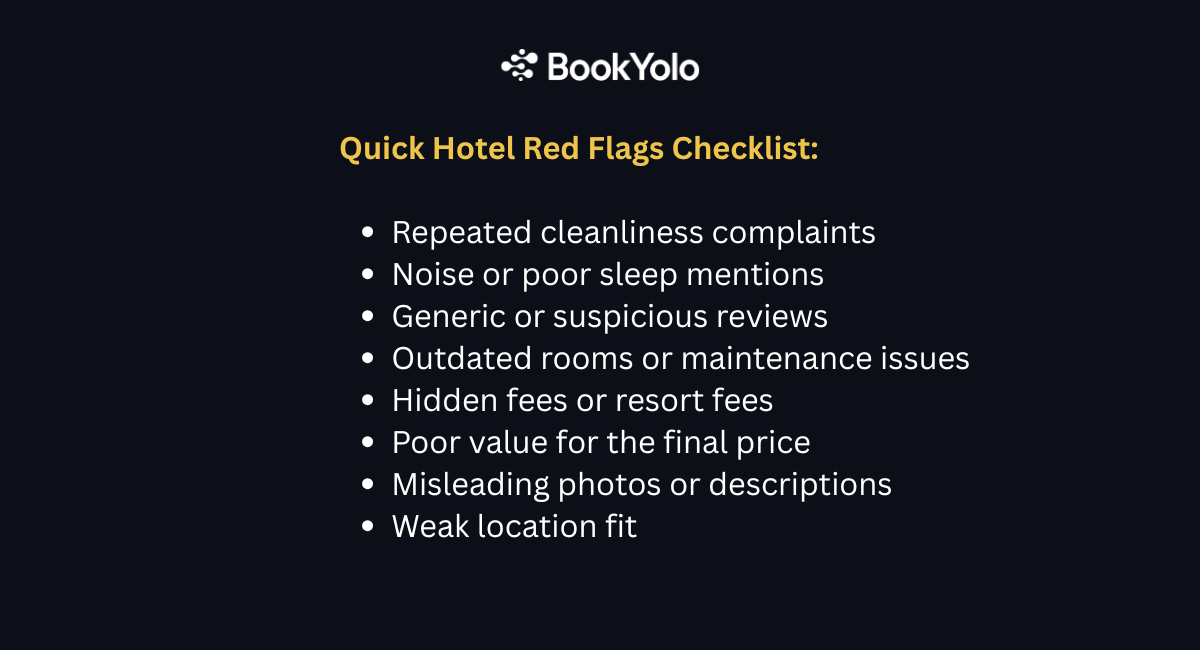
Common hotel red flags include repeated cleanliness complaints, vague positive reviews with little detail, suspicious review patterns, noise concerns, old or poorly maintained rooms, weak air conditioning or heating, unreliable Wi-Fi, hidden fees, parking surprises, poor service recovery, misleading photos, location concerns, and poor value for the price.
The goal is not to scare yourself out of every hotel. The goal is to understand what kind of stay you are actually booking. A hotel can still be a good choice if the red flags do not matter to your trip. But you should know about them before you pay.
For a focused tool-style page, use the Hotel Red Flag Checker
Hotel red flags before booking
Hotel red flags are warning signs that a property may not match what travelers expect from the listing, rating, photos, or price. They do not always mean a hotel is bad. They mean the hotel deserves a closer look before you commit.
A single negative review does not automatically make a hotel risky. Every property can have occasional issues. The stronger signal is repetition. If multiple guests mention similar concerns, even in polite or softened language, that pattern matters more than one dramatic complaint.
For example, one guest saying a room was noisy may not mean much. But if several guests mention street noise, thin walls, hallway noise, nearby bars, or poor sleep, that becomes a real sleep-quality signal. The same logic applies to cleanliness, maintenance, value, location, and service.
Common hotel red flags include repeated cleanliness complaints, vague positive reviews with little detail, suspicious review patterns, noise concerns, old or poorly maintained rooms, weak air conditioning or heating, unreliable Wi-Fi, hidden fees, parking surprises, poor service recovery, misleading photos, location concerns, and poor value for the price.
The goal is not to scare yourself out of every hotel. The goal is to understand what kind of stay you are actually booking. A hotel can still be a good choice if the red flags do not matter to your trip. But you should know about them before you pay.
For a focused tool-style page, use the Hotel Red Flag Checker
Why highly rated hotels can still disappoint
High ratings are useful, but they do not always tell the full story.
A hotel can have a strong overall rating and still be the wrong fit for your trip. This often happens because ratings compress many different experiences into one number. A guest may give a high score because the staff was friendly or the location was convenient, even if the room was small, noisy, or outdated.
Travelers also have different tolerance levels. A business traveler may care deeply about Wi-Fi, sleep quality, and desk setup. A family may care more about cleanliness, space, safety, and breakfast. A budget traveler may tolerate older rooms if the price is low. A couple on a special trip may not.
This is why a hotel can be “good overall” but still disappoint you personally. The overall rating may not reflect your specific priorities.
Highly rated hotels can still have small rooms, thin walls, outdated bathrooms, slow elevators, inconsistent housekeeping, street noise, expensive parking, weak breakfast, poor Wi-Fi, or poor value for the price.
The trick is to separate general popularity from actual fit. A popular hotel may be fine for some travelers and wrong for others. BookYolo helps by looking beyond the rating and surfacing patterns that may affect the stay experience.
When you check a hotel, look for repeated signals that answer a more useful question:
Is this hotel likely to match what I need for this trip?
Hotel review warning signs travelers miss
Hotel reviews are often more useful when you read between the lines.
Many travelers only scan the rating and a few recent comments. That is understandable. Reading hundreds of reviews is tiring, and many reviews repeat the same generic language. But the important signals are often hidden in patterns across many reviews, not in one isolated comment.
Some hotel review warning signs are obvious. If several guests say the room was dirty, the air conditioning did not work, or the area felt unsafe, that is easy to understand. But many warning signs are softer. Guests often write in cautious or balanced language, especially when they are trying to be fair.
Watch for phrases such as “good enough,” “fine for one night,” “basic but acceptable,” “could use updating,” “not terrible, but…,” “location was convenient, although…,” “room was small but manageable,” or “staff was nice, but…”
None of these phrases automatically means a hotel is bad. But they can suggest a gap between the listing promise and the real experience. If that kind of language appears repeatedly, it may signal that the hotel is acceptable rather than genuinely strong.
The most important review signals are repeated themes: multiple guests mentioning noise, several comments about cleanliness, recurring complaints about outdated rooms, repeated service issues, frequent comments about fees or poor value, or mixed feedback about location safety or convenience.
This is where a hotel review checker is useful. Instead of relying only on the rating, you can look at the review patterns that explain what the stay may actually feel like.
For deeper review-pattern analysis, use the Hotel Review Checker
Fake or suspicious hotel review patterns
Fake reviews are not always obvious.
Some suspicious reviews look extremely positive but provide little useful detail. Others repeat similar phrases, sound overly promotional, or avoid mentioning anything specific about the actual stay. The issue is not always that a review is fake. Sometimes the issue is that the review is too generic to help you make a real booking decision.
Useful hotel reviews usually contain concrete details. They mention the room, bed, bathroom, noise, service, location, breakfast, cleanliness, check-in, Wi-Fi, or value. Weak reviews often say things like “great stay,” “amazing hotel,” or “perfect location” without explaining why.
Suspicious review signals can include very generic praise, repeated wording across reviews, many short reviews with little substance, unusually perfect language, reviews that sound promotional rather than personal, praise that does not mention the room or actual stay experience, and strong ratings without meaningful detail.
Another warning sign is a mismatch between the rating and the review text. A guest might leave a positive score while mentioning several problems. That does not mean the review is fake, but it does mean the rating alone may be misleading.
Fake or low-quality review signals are especially important when a hotel has many perfect reviews but very little specific information. Travelers should not panic when they see generic reviews, but they should avoid relying on them too heavily.
For the dedicated tool page, use the Fake Hotel Review Detector
Why highly rated hotels can still disappoint
High ratings are useful, but they do not always tell the full story.
A hotel can have a strong overall rating and still be the wrong fit for your trip. This often happens because ratings compress many different experiences into one number. A guest may give a high score because the staff was friendly or the location was convenient, even if the room was small, noisy, or outdated.
Travelers also have different tolerance levels. A business traveler may care deeply about Wi-Fi, sleep quality, and desk setup. A family may care more about cleanliness, space, safety, and breakfast. A budget traveler may tolerate older rooms if the price is low. A couple on a special trip may not.
This is why a hotel can be “good overall” but still disappoint you personally. The overall rating may not reflect your specific priorities.
Highly rated hotels can still have small rooms, thin walls, outdated bathrooms, slow elevators, inconsistent housekeeping, street noise, expensive parking, weak breakfast, poor Wi-Fi, or poor value for the price.
The trick is to separate general popularity from actual fit. A popular hotel may be fine for some travelers and wrong for others. BookYolo helps by looking beyond the rating and surfacing patterns that may affect the stay experience.
When you check a hotel, look for repeated signals that answer a more useful question:
Is this hotel likely to match what I need for this trip?
Hotel review warning signs travelers miss
Hotel reviews are often more useful when you read between the lines.
Many travelers only scan the rating and a few recent comments. That is understandable. Reading hundreds of reviews is tiring, and many reviews repeat the same generic language. But the important signals are often hidden in patterns across many reviews, not in one isolated comment.
Some hotel review warning signs are obvious. If several guests say the room was dirty, the air conditioning did not work, or the area felt unsafe, that is easy to understand. But many warning signs are softer. Guests often write in cautious or balanced language, especially when they are trying to be fair.
Watch for phrases such as “good enough,” “fine for one night,” “basic but acceptable,” “could use updating,” “not terrible, but…,” “location was convenient, although…,” “room was small but manageable,” or “staff was nice, but…”
None of these phrases automatically means a hotel is bad. But they can suggest a gap between the listing promise and the real experience. If that kind of language appears repeatedly, it may signal that the hotel is acceptable rather than genuinely strong.
The most important review signals are repeated themes: multiple guests mentioning noise, several comments about cleanliness, recurring complaints about outdated rooms, repeated service issues, frequent comments about fees or poor value, or mixed feedback about location safety or convenience.
This is where a hotel review checker is useful. Instead of relying only on the rating, you can look at the review patterns that explain what the stay may actually feel like.
For deeper review-pattern analysis, use the Hotel Review Checker
Fake or suspicious hotel review patterns
Fake reviews are not always obvious.
Some suspicious reviews look extremely positive but provide little useful detail. Others repeat similar phrases, sound overly promotional, or avoid mentioning anything specific about the actual stay. The issue is not always that a review is fake. Sometimes the issue is that the review is too generic to help you make a real booking decision.
Useful hotel reviews usually contain concrete details. They mention the room, bed, bathroom, noise, service, location, breakfast, cleanliness, check-in, Wi-Fi, or value. Weak reviews often say things like “great stay,” “amazing hotel,” or “perfect location” without explaining why.
Suspicious review signals can include very generic praise, repeated wording across reviews, many short reviews with little substance, unusually perfect language, reviews that sound promotional rather than personal, praise that does not mention the room or actual stay experience, and strong ratings without meaningful detail.
Another warning sign is a mismatch between the rating and the review text. A guest might leave a positive score while mentioning several problems. That does not mean the review is fake, but it does mean the rating alone may be misleading.
Fake or low-quality review signals are especially important when a hotel has many perfect reviews but very little specific information. Travelers should not panic when they see generic reviews, but they should avoid relying on them too heavily.
For the dedicated tool page, use the Fake Hotel Review Detector
Check a Hotel Before Booking In Seconds
Checking a hotel? BookYolo helps analyze review patterns, guest complaints, and stay-quality signals before you book.
Cleanliness red flags in hotel reviews
Cleanliness is one of the most important hotel signals because it directly affects comfort, trust, and sleep quality.
A hotel can have a great location and still feel disappointing if the room does not feel fresh. Cleanliness issues are also hard to judge from photos. Booking images are usually staged, edited, or taken from the best available rooms. Reviews are often where the real cleanliness signals appear.
The challenge is that cleanliness complaints are sometimes softened. Guests may not always write “the room was dirty.” Instead, they may say the room “could have been cleaner,” the bathroom “needed attention,” the carpet was “old,” or the room felt “dated.” These phrases can be mild, but if they repeat, they matter.
Watch for repeated mentions of musty smells, stains, dusty rooms, bathroom issues, old carpets, mold or dampness, bedding concerns, poor housekeeping, rooms not feeling fresh, or comments like “dated but acceptable.”
It is also important to distinguish between “dated” and “dirty.” A dated hotel may still be clean and well-run. But if guests mention smells, stains, bathroom problems, or inconsistent housekeeping, that is a different kind of risk.
One cleanliness complaint may not be decisive. But repeated cleanliness concerns are a serious hotel red flag, especially for families, longer stays, higher-priced hotels, and trips where comfort matters.
Cleanliness red flags in hotel reviews
Cleanliness is one of the most important hotel signals because it directly affects comfort, trust, and sleep quality.
A hotel can have a great location and still feel disappointing if the room does not feel fresh. Cleanliness issues are also hard to judge from photos. Booking images are usually staged, edited, or taken from the best available rooms. Reviews are often where the real cleanliness signals appear.
The challenge is that cleanliness complaints are sometimes softened. Guests may not always write “the room was dirty.” Instead, they may say the room “could have been cleaner,” the bathroom “needed attention,” the carpet was “old,” or the room felt “dated.” These phrases can be mild, but if they repeat, they matter.
Watch for repeated mentions of musty smells, stains, dusty rooms, bathroom issues, old carpets, mold or dampness, bedding concerns, poor housekeeping, rooms not feeling fresh, or comments like “dated but acceptable.”
It is also important to distinguish between “dated” and “dirty.” A dated hotel may still be clean and well-run. But if guests mention smells, stains, bathroom problems, or inconsistent housekeeping, that is a different kind of risk.
One cleanliness complaint may not be decisive. But repeated cleanliness concerns are a serious hotel red flag, especially for families, longer stays, higher-priced hotels, and trips where comfort matters.
Maintenance and amenity warning signs
A hotel can have attractive photos but still feel poorly maintained in person.
Maintenance issues often show up as small inconveniences: weak air conditioning, slow elevators, unreliable Wi-Fi, old mattresses, plumbing issues, worn furniture, or hot water problems. One issue may not ruin a stay. But repeated maintenance complaints can point to a property that is not being managed carefully.
Amenities deserve the same attention. A hotel may advertise a pool, gym, breakfast, parking, business center, restaurant, or workspace, but the actual experience may be limited, crowded, closed, expensive, or underwhelming. A listed amenity only matters if it works and matches what travelers expect.
This is especially important when an amenity is central to your trip. If you need reliable Wi-Fi for work, a hotel with repeated Wi-Fi complaints is risky. If you are traveling in summer, weak air conditioning is not a small detail. If you are traveling with family, broken elevators or poor room maintenance can quickly become stressful.
Common hotel maintenance red flags include weak air conditioning, poor heating, unreliable Wi-Fi, slow or broken elevators, plumbing issues, hot water problems, old mattresses, worn furniture, broken fixtures, poor soundproofing, and amenities not working as expected.
Before booking, check whether the amenities that matter to you are consistently praised or repeatedly questioned. A hotel can still be worth booking if the issues do not affect your needs, but you should know about them upfront.
Maintenance and amenity warning signs
A hotel can have attractive photos but still feel poorly maintained in person.
Maintenance issues often show up as small inconveniences: weak air conditioning, slow elevators, unreliable Wi-Fi, old mattresses, plumbing issues, worn furniture, or hot water problems. One issue may not ruin a stay. But repeated maintenance complaints can point to a property that is not being managed carefully.
Amenities deserve the same attention. A hotel may advertise a pool, gym, breakfast, parking, business center, restaurant, or workspace, but the actual experience may be limited, crowded, closed, expensive, or underwhelming. A listed amenity only matters if it works and matches what travelers expect.
This is especially important when an amenity is central to your trip. If you need reliable Wi-Fi for work, a hotel with repeated Wi-Fi complaints is risky. If you are traveling in summer, weak air conditioning is not a small detail. If you are traveling with family, broken elevators or poor room maintenance can quickly become stressful.
Common hotel maintenance red flags include weak air conditioning, poor heating, unreliable Wi-Fi, slow or broken elevators, plumbing issues, hot water problems, old mattresses, worn furniture, broken fixtures, poor soundproofing, and amenities not working as expected.
Before booking, check whether the amenities that matter to you are consistently praised or repeatedly questioned. A hotel can still be worth booking if the issues do not affect your needs, but you should know about them upfront.
Noise red flags and sleep-quality risks
Noise is one of the easiest hotel problems to underestimate before booking.
A hotel can be clean, well-located, and highly rated, but still be a poor fit if you cannot sleep. Noise problems can come from the street, nightlife, traffic, trains, construction, elevators, hallways, neighboring rooms, or poor soundproofing. For light sleepers, families, business travelers, or anyone arriving after a long flight, this can matter more than the hotel’s overall rating.
The challenge is that noise complaints are often scattered across reviews. One guest may mention street noise. Another may mention thin walls. Another may say the location is “lively.” Another may simply say they did not sleep well. Individually, those comments may not look serious. Together, they can reveal a real sleep-quality risk.
Some positive location language can also be a clue. Phrases like “central,” “lively,” “close to nightlife,” or “great for exploring” may be positive for convenience, but they can also mean more noise. The right question is not whether the location is good. It is whether the location matches your travel style.
Watch for repeated mentions of street noise, nightlife nearby, thin walls, hallway noise, elevator noise, neighboring rooms, construction, traffic, music, bars nearby, or poor soundproofing.
If sleep quality matters to your trip, noise deserves its own check before booking.
Noise red flags and sleep-quality risks
Noise is one of the easiest hotel problems to underestimate before booking.
A hotel can be clean, well-located, and highly rated, but still be a poor fit if you cannot sleep. Noise problems can come from the street, nightlife, traffic, trains, construction, elevators, hallways, neighboring rooms, or poor soundproofing. For light sleepers, families, business travelers, or anyone arriving after a long flight, this can matter more than the hotel’s overall rating.
The challenge is that noise complaints are often scattered across reviews. One guest may mention street noise. Another may mention thin walls. Another may say the location is “lively.” Another may simply say they did not sleep well. Individually, those comments may not look serious. Together, they can reveal a real sleep-quality risk.
Some positive location language can also be a clue. Phrases like “central,” “lively,” “close to nightlife,” or “great for exploring” may be positive for convenience, but they can also mean more noise. The right question is not whether the location is good. It is whether the location matches your travel style.
Watch for repeated mentions of street noise, nightlife nearby, thin walls, hallway noise, elevator noise, neighboring rooms, construction, traffic, music, bars nearby, or poor soundproofing.
If sleep quality matters to your trip, noise deserves its own check before booking.
Hidden hotel fees
The price you first see is not always the price you effectively pay.
Hotel hidden fees can change the real value of a stay. A hotel may look affordable in search results, but the final cost can increase once resort fees, destination fees, parking, breakfast, taxes, service charges, or deposits are included.
Fees are not always a reason to avoid a hotel. A hotel with fees can still be worth booking if the quality, location, and experience justify the total price. The problem is when the hotel appears cheaper than it really is, or when the final price no longer matches the guest experience.
Common hotel hidden-fee red flags include resort fees, destination fees, parking fees, early check-in charges, late checkout charges, breakfast charges, Wi-Fi charges, local taxes, security deposits, facility fees, and unclear payment policies.
The most important question is not just “Are there fees?” The better question is:
Does the final price still make sense for the quality of this hotel?
A cheap-looking hotel can become poor value once the total cost is clear. A more expensive hotel can be better value if it avoids surprises and delivers a better stay.
Hidden hotel fees
The price you first see is not always the price you effectively pay.
Hotel hidden fees can change the real value of a stay. A hotel may look affordable in search results, but the final cost can increase once resort fees, destination fees, parking, breakfast, taxes, service charges, or deposits are included.
Fees are not always a reason to avoid a hotel. A hotel with fees can still be worth booking if the quality, location, and experience justify the total price. The problem is when the hotel appears cheaper than it really is, or when the final price no longer matches the guest experience.
Common hotel hidden-fee red flags include resort fees, destination fees, parking fees, early check-in charges, late checkout charges, breakfast charges, Wi-Fi charges, local taxes, security deposits, facility fees, and unclear payment policies.
The most important question is not just “Are there fees?” The better question is:
Does the final price still make sense for the quality of this hotel?
A cheap-looking hotel can become poor value once the total cost is clear. A more expensive hotel can be better value if it avoids surprises and delivers a better stay.
Overpriced hotels and price-vs-quality mismatch
A hotel does not need to be terrible to be overpriced.
Sometimes the real issue is that the stay does not justify the price. This is especially common in popular destinations, event periods, high-demand neighborhoods, and tourist-heavy areas. A hotel may be acceptable, but still not worth what it costs.
Price-vs-quality mismatch can show up in many ways. Guests may say the room was small, the hotel was dated, breakfast was weak, service was average, parking was expensive, or the hotel was “fine” but not memorable. None of that means the hotel is bad. But if the price is high, “fine” may not be enough.
Signs a hotel may be overpriced include high price but average guest experience, repeated complaints about small rooms, weak amenities for the rate, cleanliness concerns despite premium pricing, service that does not match the category, expensive parking or resort fees, better nearby alternatives at similar prices, or reviews suggesting the hotel is merely acceptable.
This matters because travelers often compare hotels by rating, not by fit. A highly rated hotel may still be a poor value if the guest experience does not match the price.
The key question is not only “Is this hotel bad?” It is:
Is this hotel worth booking at this price?
How to check if a hotel is worth booking
Before booking a hotel, check four things together.
First, look at review patterns. Are guests repeating the same concerns? A single bad review may not matter, but recurring issues are worth attention.
Second, look at expectation fit. Does the listing match what guests actually describe? If the photos and description suggest a polished stay, but reviews describe dated rooms, poor soundproofing, or inconsistent cleanliness, there may be an expectation gap.
Third, look at stay-quality risks. Are there signs of noise, cleanliness issues, maintenance problems, poor service, hidden fees, or weak location fit? These are the issues that often create booking regret.
Fourth, look at value for money. Does the quality justify the total price? A hotel can be acceptable but still overpriced. Another hotel can be basic but fair for the cost.
This is where BookYolo helps. Instead of forcing you to read scattered reviews manually, BookYolo checks the hotel for stay-quality signals and gives you a clearer pre-booking view.
Use the dedicated page below to decide: Should I Book This Hotel?
Use BookYolo to check hotel red flags before you book
BookYolo helps travelers inspect hotels before booking by looking beyond simple ratings.
Instead of only asking whether a hotel is highly rated, BookYolo helps travelers understand what kind of experience the hotel may actually deliver. It checks for patterns that are easy to miss manually, especially when reviews are long, repetitive, vague, or overly positive.
BookYolo can help surface repeated guest concerns, hotel review warning signs, fake or suspicious review patterns, cleanliness signals, noise complaints, maintenance issues, hidden fee concerns, price-vs-quality mismatch, and expectation gaps between the listing and the guest experience.
This is useful when a hotel looks good online but you want a second layer of analysis before committing. It is also useful when you are comparing multiple hotels that all seem similar from the outside.
Use the Hotel Red Flag Checker
See real hotel checks
Want to see how BookYolo evaluates real stays?
Browse published BookYolo stay checks to see how hotels and vacation rentals are reviewed for red flags, review patterns, expectation gaps, and stay-quality signals.
The scan library helps turn the idea of a hotel red flag check into something concrete. Instead of only reading about what to look for, you can explore examples of how BookYolo presents stay-quality signals across real hotels and vacation rentals.
Browse checked hotels and vacation rentals
Related hotel booking guides
Other BookYolo resources
Hotel red flags FAQ
What are the biggest hotel red flags before booking?
The biggest hotel red flags are repeated complaints about cleanliness, noise, poor maintenance, weak service, hidden fees, misleading photos, bad location fit, and poor value for the price. A single complaint may not matter, but repeated patterns should be checked carefully.
Can a highly rated hotel still be risky?
Yes. A highly rated hotel can still have issues that matter to your trip, such as noisy rooms, small spaces, outdated facilities, expensive fees, poor housekeeping, or weak soundproofing. Ratings are useful, but they do not always show the full stay experience.
How do I spot hotel review warning signs?
Look for repeated themes across reviews. Pay attention to softened language such as “fine for one night,” “could use updating,” “good enough,” or “not terrible, but…” These phrases can reveal issues that are easy to miss if you only look at the overall rating.
How can I tell if hotel reviews are fake or suspicious?
Suspicious hotel reviews may use generic praise, repeated wording, overly perfect language, or vague comments that do not describe the actual stay. The issue is not always fake reviews alone. It can also be low-quality review signals that do not help travelers make a good decision.
What cleanliness red flags should I check in hotel reviews?
Look for repeated mentions of smells, stains, bathroom issues, dusty rooms, mold, old carpets, poor housekeeping, or rooms that did not feel fresh. Cleanliness issues are especially important when they appear across multiple reviews.
How do I know if a hotel will be noisy?
Look for mentions of street noise, nightlife, thin walls, traffic, construction, hallway noise, elevator noise, or poor soundproofing. Also watch for location language such as “central” or “lively,” which can be positive but may also suggest noise.
What hidden fees should I check before booking a hotel?
Check for resort fees, parking fees, destination fees, breakfast charges, Wi-Fi charges, taxes, deposits, and early check-in or late checkout fees. The key question is whether the final price still matches the quality of the stay.
How do I know if a hotel is overpriced?
A hotel may be overpriced if the total cost is high but reviews suggest average rooms, weak amenities, cleanliness concerns, poor service, bad sleep quality, or extra fees. The question is whether the stay quality justifies the final price.
How can BookYolo help me check hotel red flags?
BookYolo helps travelers inspect hotels before booking by analyzing review patterns, red flags, suspicious review signals, cleanliness concerns, noise risks, maintenance issues, hidden fees, and expectation gaps. It gives travelers a clearer view before they commit.
Overpriced hotels and price-vs-quality mismatch
A hotel does not need to be terrible to be overpriced.
Sometimes the real issue is that the stay does not justify the price. This is especially common in popular destinations, event periods, high-demand neighborhoods, and tourist-heavy areas. A hotel may be acceptable, but still not worth what it costs.
Price-vs-quality mismatch can show up in many ways. Guests may say the room was small, the hotel was dated, breakfast was weak, service was average, parking was expensive, or the hotel was “fine” but not memorable. None of that means the hotel is bad. But if the price is high, “fine” may not be enough.
Signs a hotel may be overpriced include high price but average guest experience, repeated complaints about small rooms, weak amenities for the rate, cleanliness concerns despite premium pricing, service that does not match the category, expensive parking or resort fees, better nearby alternatives at similar prices, or reviews suggesting the hotel is merely acceptable.
This matters because travelers often compare hotels by rating, not by fit. A highly rated hotel may still be a poor value if the guest experience does not match the price.
The key question is not only “Is this hotel bad?” It is:
Is this hotel worth booking at this price?
How to check if a hotel is worth booking
Before booking a hotel, check four things together.
First, look at review patterns. Are guests repeating the same concerns? A single bad review may not matter, but recurring issues are worth attention.
Second, look at expectation fit. Does the listing match what guests actually describe? If the photos and description suggest a polished stay, but reviews describe dated rooms, poor soundproofing, or inconsistent cleanliness, there may be an expectation gap.
Third, look at stay-quality risks. Are there signs of noise, cleanliness issues, maintenance problems, poor service, hidden fees, or weak location fit? These are the issues that often create booking regret.
Fourth, look at value for money. Does the quality justify the total price? A hotel can be acceptable but still overpriced. Another hotel can be basic but fair for the cost.
This is where BookYolo helps. Instead of forcing you to read scattered reviews manually, BookYolo checks the hotel for stay-quality signals and gives you a clearer pre-booking view.
Use the dedicated page below to decide: Should I Book This Hotel?
Use BookYolo to check hotel red flags before you book
BookYolo helps travelers inspect hotels before booking by looking beyond simple ratings.
Instead of only asking whether a hotel is highly rated, BookYolo helps travelers understand what kind of experience the hotel may actually deliver. It checks for patterns that are easy to miss manually, especially when reviews are long, repetitive, vague, or overly positive.
BookYolo can help surface repeated guest concerns, hotel review warning signs, fake or suspicious review patterns, cleanliness signals, noise complaints, maintenance issues, hidden fee concerns, price-vs-quality mismatch, and expectation gaps between the listing and the guest experience.
This is useful when a hotel looks good online but you want a second layer of analysis before committing. It is also useful when you are comparing multiple hotels that all seem similar from the outside.
Use the Hotel Red Flag Checker
See real hotel checks
Want to see how BookYolo evaluates real stays?
Browse published BookYolo stay checks to see how hotels and vacation rentals are reviewed for red flags, review patterns, expectation gaps, and stay-quality signals.
The scan library helps turn the idea of a hotel red flag check into something concrete. Instead of only reading about what to look for, you can explore examples of how BookYolo presents stay-quality signals across real hotels and vacation rentals.
Browse checked hotels and vacation rentals
Related hotel booking guides
Other BookYolo resources
Hotel red flags FAQ
What are the biggest hotel red flags before booking?
The biggest hotel red flags are repeated complaints about cleanliness, noise, poor maintenance, weak service, hidden fees, misleading photos, bad location fit, and poor value for the price. A single complaint may not matter, but repeated patterns should be checked carefully.
Can a highly rated hotel still be risky?
Yes. A highly rated hotel can still have issues that matter to your trip, such as noisy rooms, small spaces, outdated facilities, expensive fees, poor housekeeping, or weak soundproofing. Ratings are useful, but they do not always show the full stay experience.
How do I spot hotel review warning signs?
Look for repeated themes across reviews. Pay attention to softened language such as “fine for one night,” “could use updating,” “good enough,” or “not terrible, but…” These phrases can reveal issues that are easy to miss if you only look at the overall rating.
How can I tell if hotel reviews are fake or suspicious?
Suspicious hotel reviews may use generic praise, repeated wording, overly perfect language, or vague comments that do not describe the actual stay. The issue is not always fake reviews alone. It can also be low-quality review signals that do not help travelers make a good decision.
What cleanliness red flags should I check in hotel reviews?
Look for repeated mentions of smells, stains, bathroom issues, dusty rooms, mold, old carpets, poor housekeeping, or rooms that did not feel fresh. Cleanliness issues are especially important when they appear across multiple reviews.
How do I know if a hotel will be noisy?
Look for mentions of street noise, nightlife, thin walls, traffic, construction, hallway noise, elevator noise, or poor soundproofing. Also watch for location language such as “central” or “lively,” which can be positive but may also suggest noise.
What hidden fees should I check before booking a hotel?
Check for resort fees, parking fees, destination fees, breakfast charges, Wi-Fi charges, taxes, deposits, and early check-in or late checkout fees. The key question is whether the final price still matches the quality of the stay.
How do I know if a hotel is overpriced?
A hotel may be overpriced if the total cost is high but reviews suggest average rooms, weak amenities, cleanliness concerns, poor service, bad sleep quality, or extra fees. The question is whether the stay quality justifies the final price.
How can BookYolo help me check hotel red flags?
BookYolo helps travelers inspect hotels before booking by analyzing review patterns, red flags, suspicious review signals, cleanliness concerns, noise risks, maintenance issues, hidden fees, and expectation gaps. It gives travelers a clearer view before they commit.
Check the actual quality of your next stay before you book
Let BookYolo uncover what really matters before you lock in your next stay. Run your first scan in seconds.

Apps & Integrations
Travel Guides
Popular Tools
BookYolo uses artificial intelligence and can make mistakes. Always verify important information before making a booking decision.
© 2026 BookYolo Pte. Ltd. All rights reserved. Photos credit: Ian Schneider, Clay Banks, Alex Bertha.
Check the actual quality of your next stay before you book
Let BookYolo uncover what really matters before you lock in your next stay. Run your first scan in seconds.
Apps & Integrations
Travel Guides
Popular Tools
BookYolo uses artificial intelligence and can make mistakes. Always verify important information before making a booking decision.
© 2026 BookYolo Pte. Ltd. All rights reserved. Photos credit: Ian Schneider, Clay Banks, Alex Bertha.
Check the actual quality of your next stay before you book
Let BookYolo uncover what really matters before you lock in your next stay. Run your first scan in seconds.
Apps & Integrations
Travel Guides
Popular Tools
BookYolo uses artificial intelligence and can make mistakes. Always verify important information before making a booking decision.
© 2026 BookYolo Pte. Ltd. All rights reserved. Photos credit: Ian Schneider, Clay Banks, Alex Bertha.
Check the actual quality of your next stay before you book
Let BookYolo uncover what really matters before you lock in your next stay. Run your first scan in seconds.
Apps & Integrations
Travel Guides
Popular Tools
BookYolo uses artificial intelligence and can make mistakes. Always verify important information before making a booking decision.
© 2026 BookYolo Pte. Ltd. All rights reserved. Photos credit: Ian Schneider, Clay Banks, Alex Bertha.
Check the actual quality of your next stay before you book
Let BookYolo uncover what really matters before you lock in your next stay. Run your first scan in seconds.
Apps & Integrations
Travel Guides
Popular Tools
BookYolo uses artificial intelligence and can make mistakes. Always verify important information before making a booking decision.
© 2026 BookYolo Pte. Ltd. All rights reserved. Photos credit: Ian Schneider, Clay Banks, Alex Bertha.